 Chinyere Okorocha
A woman can choose the right profession, earn the right qualifications, work harder than everyone around her, and still find her career limited by one decision she made outside the workplace.
The person she married.
We spend a great deal of time talking about what women need to succeed at work. We discuss qualifications, confidence, networking, visibility, mentorship, sponsorship and leadership skills. All of these matter.
But there is one factor that is rarely discussed openly, even though it influences a woman’s career more than many people realise.
Over my 35-year career, mentoring hundreds of women and meeting female professionals across more than 40 countries spanning Africa, Europe, North America, Asia and Australia, I have observed a pattern that is impossible to ignore.
Women with supportive husbands often have greater freedom to pursue opportunities, accept leadership roles, travel for work and invest in their own growth. Women whose husbands resist or undermine their ambitions frequently find themselves fighting two battles at once: one at work and another at home.
That second battle is exhausting.
Support Creates Possibilities
A career is not built only in the office. It is also shaped by the conversations around the dining table, the encouragement—or discouragement—you receive at home, and whether your biggest supporter is standing beside you or standing in your way.
A supportive husband does not eliminate the hard work. You will still make sacrifices and face setbacks.
What support does is create possibilities.
It gives you the confidence to say yes to opportunities that stretch you. It gives you the freedom to attend conferences, pursue further education, accept international assignments or take on leadership positions without carrying the burden of unnecessary conflict at home.
When your husband believes in your potential, he doesn’t simply celebrate your success; he helps create the conditions that make that success possible.
A Lesson From My Own Marriage
I count myself fortunate.
Many years ago, when one of our children was just four months old, I received an important opportunity to travel overseas for work.
As a new mother, I wanted to continue breastfeeding. Living in Nigeria, where electricity supply was—and still can be—unreliable, safely storing expressed breast milk was a real challenge.
My husband never questioned whether I should travel.
He simply asked, “How do we make this work?”
His solution was to buy a generator so I could express and safely freeze enough breast milk before my trip.
To some, it may seem like a small gesture.
To me, it was much more than that.
It was a practical demonstration that my career mattered too.
That single act removed an obstacle and allowed me to embrace an important professional opportunity while continuing to care for my baby.
Support is not always dramatic. Sometimes it is simply someone choosing to remove barriers instead of creating them.
When Home Becomes the Biggest Obstacle
Sadly, not every woman enjoys this experience.
I have met women who declined international assignments because their husbands refused to let them travel.
Others turned down promotions because increased responsibility created conflict at home.
Some abandoned postgraduate degrees, leadership opportunities or businesses because they became emotionally exhausted from constantly defending their ambitions.
Over time, careers slow down—not because these women lack competence or potential, but because they are carrying a burden that many of their male counterparts simply do not face.
The emotional cost is often invisible. Constant resistance at home drains confidence, limits ambition and eventually causes many women to stop reaching for opportunities they would otherwise have embraced.
What Can Women Do?
While we cannot change another person’s mindset overnight, there are practical steps that can help.
First, approach the conversation as partners, not opponents. Help your husband understand why an opportunity matters—not only for your personal fulfilment but also for your family’s long-term future.
Second, present solutions, not just requests. Think through childcare, household responsibilities and practical support before raising the conversation. Where possible, engage trusted family members or domestic staff. A well-thought-out plan is often easier to support than uncertainty.
Third, involve your husband in your journey. Celebrate your wins together. Share your challenges. Help him see that your success is not a threat to the family; it is an investment in the family’s future.
Finally, remember that support should be mutual. The healthiest marriages are those in which both partners intentionally create space for each other to flourish.
One of the Most Important Career Decisions You Will Ever Make
We often say that choosing a career is one of life’s biggest decisions.
For women, choosing a life partner may be just as significant.
The person you marry will not determine your talent, your intelligence or your potential. But he can either create an environment where those gifts flourish or one where they are constantly constrained.
Behind many successful women is not only talent, determination and resilience, but also a husband who believed in them enough to encourage them, champion them and sometimes make practical sacrifices so they could keep climbing.
Career success is rarely built by one person.
Very often, it is built by two.
About Author
Chinyere Okorocha
With over three decades of experience as a trailblazer in the legal profession, Chinyere Okorocha has established herself as a leading voice in law, leadership, and career growth for women. As a partner in one of the most prestigious law firms in the country, she has not only navigated the complexities of a competitive industry but has consistently broken barriers to become a sought-after leader, mentor, and advocate for women in the workplace. A devoted wife and proud mother of three, her career development platform, Heels & Ladders, is dedicated to mentoring and guiding women who aspire to redefine success, achieve career mastery, and lead with purpose.
The IWA Series 15 Conference is Here
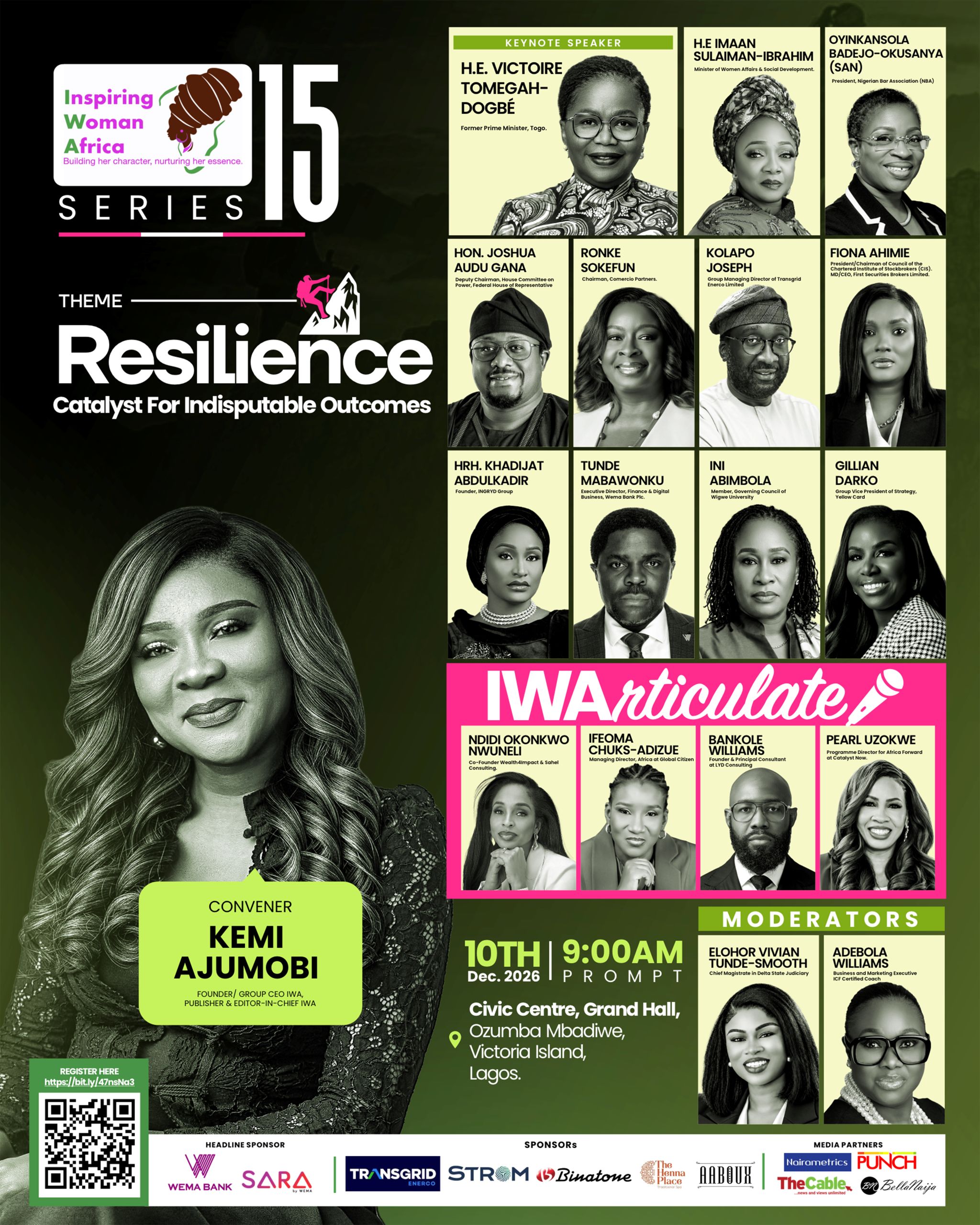
Click To Register
Latest Edition of IWA Magazine
October 20, 2026
Meet the Speakers of IWA Series 15 Conference
Latest Posts
-
 Oct 20, 2026 Hard Conversations: The Skill No One Puts on a CV
 -
 Oct 20, 2026 5 Africa Women Listed as 2026 Forbes Icons
 -
 Oct 20, 2026 You Are Wealthier Than You Think