 Kemi Ajumobi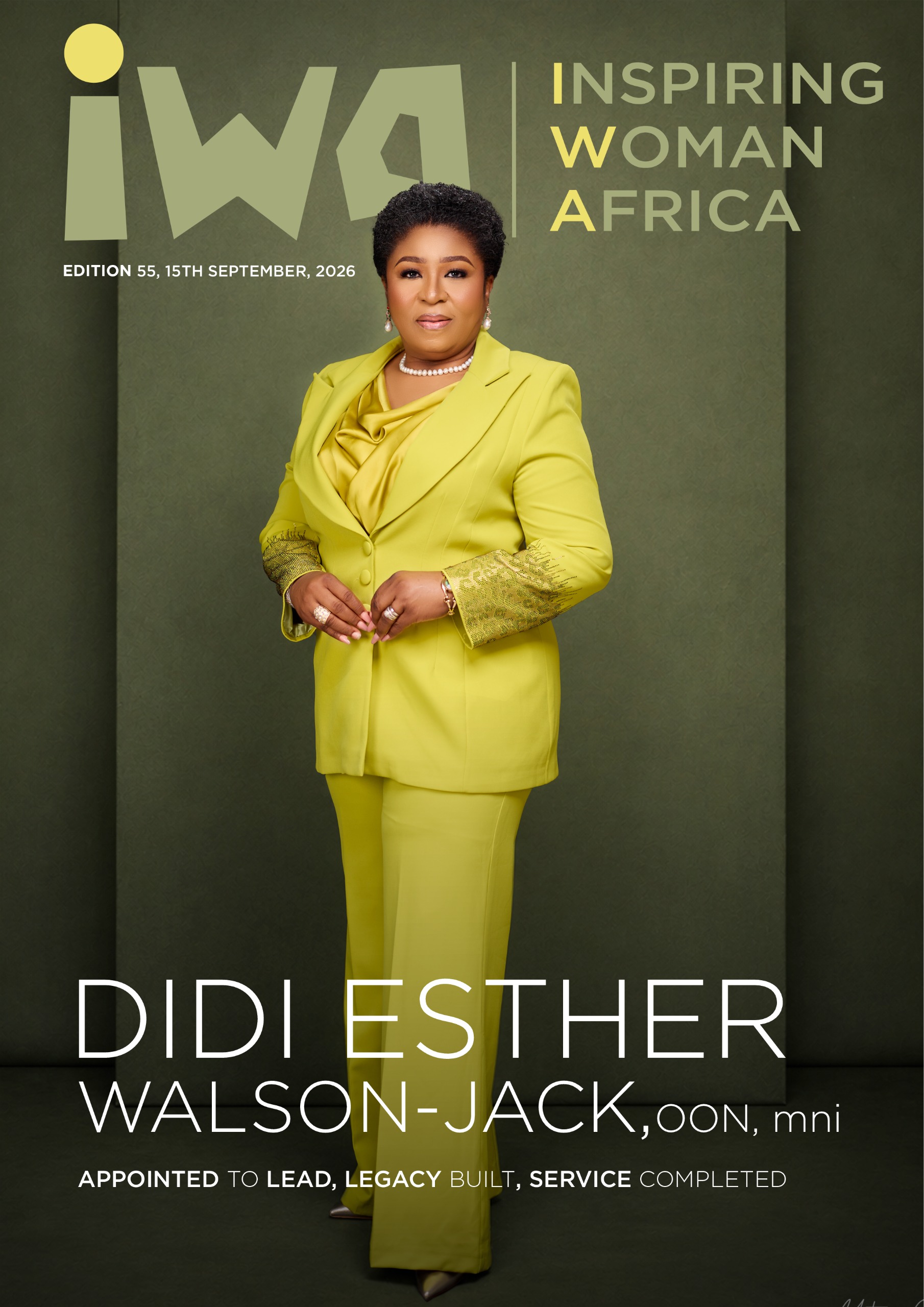
Didi Esther Walson-Jack, OON, mni, is a retired public servant of exceptional distinction and dedication, whose career has spanned more than three decades. Her journey through the Nigerian civil service, both at the state and federal levels, reflects an unwavering commitment to positive change.
Born on August 27, 1966, in Port Harcourt, Rivers State, to parents from Tombia, Ekpetiama Clan, Yenagoa Local Government Area, Bayelsa State, she has consistently demonstrated a drive to serve her community and country. Her early years laid the foundation for the distinguished career that would follow.
Walson-Jack bagged a Bachelor of Laws degree from the University of Lagos and was called to the Nigerian Bar in 1987. In addition to her legal qualifications, she is a Certified Legislative Drafter and a Conflict Resolution and Peace-Building Practitioner, which have contributed to her notable career in public administration.
A pioneering public servant in Bayelsa State, her journey in public service began in 1992, when she was appointed as a State Counsel in the Rivers State Ministry of Justice. Four years later, in 1996, with the creation of Bayelsa State, she transferred her service there. As the only certified legal drafter in the newly created state, Walson-Jack wore multiple hats, taking on the roles of Head of the Legal Drafting Department of the Ministry of Justice and Head of the Legal Department of the State House of Assembly, which she established.
Her ability to navigate both the executive and legislative arms of the state government demonstrated her exceptional capacity for leadership and governance, despite the lack of human resources available in the fledgling state.
Her trajectory in Bayelsa State government was marked by numerous significant appointments. As Solicitor-General of Bayelsa State and later Permanent Secretary in the Ministry of Justice, she played a key role in strengthening the legal framework of the state. Her service extended further, with her appointments as Deputy Chief of Staff to the Governor, Pioneer Commissioner of the Ministry of Science & Technology and Manpower Development, and Chief of Staff to the Governor. In each role, Walson-Jack’s vision for public service excellence shone through, setting her apart as a dynamic and innovative leader.
In 2009, Walson-Jack transitioned to the Federal Civil Service, joining as Assistant Director of Administration in the Ministry of Niger Delta Affairs, with responsibilities for Appointment and Discipline. Her ascent was swift, and in 2017, she was appointed Permanent Secretary in the Federal Civil Service, marking a new chapter in her public service career.
Over the years, she has served as Permanent Secretary in various ministries, including Power, Water Resources, Education, and the Office of the Head of the Civil Service of the Federation, among others.
As Permanent Secretary, she was instrumental in leading several transformative initiatives. Most notably, she pioneered the Service Welfare Office and introduced the Rewards and Recognition System, which incentivised excellence among civil servants.
Under her leadership, the Federal Integrated Staff Housing (FISH) Programme was revitalised, providing affordable housing solutions for civil servants. Her expertise in labor relations as Chair of the Joint National Public Service Negotiating Council helped to ensure industrial harmony across the civil service during her tenure.
Walson-Jack’s reformist vision has been a driving force behind numerous policy developments at the federal level. She played a pivotal role in the Tripartite and Technical Committees on National Minimum Wage and Consequential Adjustments, contributing to the negotiation and implementation of a new wage structure for civil servants. Her efforts also extended to the Civil Service Exit Management Programme, which provided pre-retirement training, offboarding services, and post-retirement schemes, ensuring that retiring civil servants were well-prepared for life after public service.
Furthermore, she initiated the Public Service Emergency Management Framework, the Civil Service Welfare Policy, and the establishment of a Centralised Counseling Centre, all of which aimed to enhance the well-being and safety of civil servants. Her attention to marginalised groups was evident in the Baseline Survey of Persons with Disabilities and the development of the Occupational Safety and Health (OSH) Policy, which ensured that the workplace remained inclusive and safe for all employees.
In July 2024, Walson-Jack was appointed Head of the Civil Service of the Federation, a role that placed her at the helm of the nation’s civil service structure. In this capacity, she served as the chief policy adviser on all civil service matters, ensuring the smooth implementation of government policies and programmes.
Walson-Jack’s contributions to public service have not gone unnoticed. She is a recipient of the Officer of the Order of the Niger (OON) and an alumna of the National Institute for Policy and Strategic Studies (NIPSS), Kuru.
Beyond her professional achievements, Walson-Jack is a devoted wife and mother. She has been married to Hon. Nimi Walson-Jack for over 35 years, and together they have raised two children and are proud grandparents. Her family life, marked by love, resilience, and faith, is a source of inspiration to those around her.
Walson-Jack is also a published author, having written her autobiography, “Roses in the Thorns,” which tells the story of her remarkable journey and the triumph of faith over adversity. The book is a testament to her strength, resilience, and ability to rise above challenges, offering inspiration to women and public servants alike.

Beginning of life’s journey
I was raised in a home where discipline, faith, and the dignity of hard work were not options but expectations. My parents believed that a good name and a good education were the only inheritances that could never be taken from a child, and that shaped everything about how I approached life afterwards. Growing up, I learnt to observe before I spoke, to finish what I started, and to treat every task — however small — as worthy of my full effort. These lessons instilled resilience, which has been central to my journey and can inspire others to persevere through challenges.
Those early lessons became the foundation of the woman who would later spend thirty-four years in public service: someone who believes that institutions are built one disciplined day at a time, not by shortcuts or self-promotion. I planted seeds early — in obedience, in patience, in service to others — and I have spent a career watching what was planted grow. My core values hardwork, integrity, diligence, and empathy, are qualities I hope readers will see as essential for effective leadership and service.
You started public service as State Counsel in Rivers State in 1992. What was that experience like for you?
In 1992, I made a choice that many around me thought was reckless. I had an offer from Oceanic Bank paying what was then a handsome fifty thousand naira a month, and I turned it down to become a State Counsel in the Rivers State Ministry of Justice, on a public service salary that was a fraction of that. I was not chasing money; I was chasing purpose.
Those early years at the Ministry of Justice taught me the discipline of the law — how to read a file with precision, how to argue with facts rather than emotion, how to respect process even when it is slow. I was a young woman finding her feet in a profession that did not always make room for one, and I had to work twice as hard to be taken seriously. It was demanding, occasionally discouraging, but it gave me the bedrock on which everything else was built. By 1996, I had gone on to top my class in the Legal Drafting course at the Nigerian Institute of Advanced Legal Studies, and that early grounding in the law shaped how I would approach public service for the next three decades.
How did the creation of Bayelsa State change your career trajectory and responsibilities?
The creation of Bayelsa State on the 1st of October 1996 was, without exaggeration, one of the defining turning points of my career. I was one of only seven pioneering Law Officers drafted to help build a Ministry of Justice from nothing — no precedent, no inherited files, no established culture to lean on. As the State’s only certified legislative drafter at the time, I drafted the military edicts that governed the new State between 1996 and 1999. I later drafted legislative bills once civilian government returned, between 1999 and 2002. It was nation-building in miniature.
Over the years that followed, I subsequently became the Solicitor-General and Permanent Secretary of the Ministry of Justice and I had the privilege of growing the Ministry from seven legal officers to seventy-two, across ten specialised departments — establishing The Justice Gazette, producing the Bayelsa State Law Report, simplifying probate procedures for small estates so that ordinary widows and children were not shut out of their inheritance by procedure, and deploying fourteen trained Law Officers directly into the Magistrates’ Courts, which the Nigerian Bar Association recognised as a first anywhere in the country. Bayelsa did not just give me a job; it gave me the responsibility of building institutions from the ground up, and that responsibility never left me for the rest of my career.
Biggest lessons from working across the executive and legislative arms of government
Working on the legislative side taught me that words carry consequences long after the room that debated them has emptied — a single ambiguous clause can undo years of good intention. Working later as Deputy Chief of Staff, and then as Chief of Staff to Governor Henry Seriake Dickson, taught me the opposite lesson: that even the most carefully drafted law is only as good as the machinery that implements it.
When I moved into Government House, I began with a listening tour before I restructured anything, because I had learned that you cannot fix what you have not first understood. I introduced proper systems for correspondence, scheduling, and follow-up, and worked closely to move Executive Bills through to legislative transmission. The biggest lesson from straddling both arms is that governance is a relay race, not a solo sprint — the drafter, the legislator and the administrator must each run their leg well, or the whole race is lost. It also taught me humility: no single arm of government can claim sole credit for good governance, and no single arm should be blamed alone when it fails.
Guiding philosophy as Permanent Secretary across multiple ministries
My guiding philosophy has always been captured in three words that now form the spine of my memoir: I planted, I believed, and I moved on. For instance, in my role as Federal Permanent Secretary, I prioritised building resilient institutions and empowering staff, demonstrating that leadership is about legacy, not personal accolades. I never saw any Ministry as a personal estate. I saw myself as a steward, planting institutions, systems and capacity that would outlive my tenure and outlive me.
I did not chase credit for what I helped to build; I chased continuity. Each Ministry had its own peculiar mandate, but I found fulfilment in seeing my team grow and succeed. By building the system, empowering the people who run it, documenting what you have done so your successor does not start from scratch, and trusting that some of what you planted will grow taller than you ever stood, I aimed to leave a lasting impact that inspires future leaders.
Key challenges in revitalising the FISH housing programme, and how they were addressed
The Federal Integrated Staff Housing Programme, FISH, is close to my heart because it speaks directly to the dignity of the ordinary civil servant. For years, many Public Servants watched housing promises come and go without ever seeing a key in their hand, and that bred understandable cynicism.
The biggest challenge in revitalising FISH was rebuilding trust as much as rebuilding structures — convincing civil servants that this was not another groundbreaking ceremony destined to stall. We addressed it by pushing for renewed funding commitments, stronger partnerships to actually complete estates rather than merely carrying out a ground-breaking exercise and by being deliberate about affordability, so that a programme meant for civil servants did not end up priced beyond their reach. Civil servants told me plainly: they want homes, not more groundbreakings. That plain-spoken challenge stayed with me throughout, and seeing groundbreaking translate into estates that are actually under construction mattered enormously to me.
Reflecting on this, I learnt that resilience, stakeholder engagement, and adaptive strategies are crucial in overcoming complex public service challenges, lessons I hope inspire aspiring leaders to persist through difficulties.

How did your role as Chair of the Joint National Public Service Negotiating Council support industrial harmony?
As Chair of the Joint National Public Service Negotiating Council, I understood early that industrial harmony is not achieved by winning arguments; it is achieved by keeping the table open before a crisis forces everyone to it. I made it a point to institute more structured, regular engagement with organised labour, rather than waiting for a strike notice to start talking.
Negotiation, in my experience, works best when both sides feel heard long before positions harden — when the government is transparent about what is possible, and labour trusts that commitments made will be honoured. It was not always smooth; public service negotiation rarely is, given the competing pressures on the public purse. But by keeping communication continuous rather than reactive, we were able to manage several potentially disruptive disputes without the service grinding to a halt, and that, to me, is what industrial harmony in a system as large as ours actually requires.
What inspired the creation of the Centralised Counselling Centre?
Civil servants carry burdens that rarely show up in a personnel file — financial pressure, family strain, grief, workplace stress — and for the longest time, the system expected them to cope in silence. What inspired the Centralised Counselling Centre was a simple conviction: a service welfare office responsible for the welfare of over a hundred thousand public servants cannot be indifferent to their psychological wellbeing and still expect their best performance.
I wanted a place where a civil servant could seek support without stigma, without their struggles becoming office gossip, and without having first to collapse before anyone noticed. It was, in many ways, an extension of the welfare-first philosophy I had carried since my early work on civil servant welfare — the belief that a civil service that cares for its people will always get more from them than one that commands them.
How did the Baseline Survey of Persons with Disabilities influence inclusiveness in workplace practices?
You cannot build inclusive policy on assumptions; you need data. Before the Baseline Survey of Persons with Disabilities, much of what the civil service “knew” about disability within its own workforce was anecdotal at best.
Commissioning that survey allowed us, for the first time, to understand with some precision how many persons with disabilities were actually serving within the system, what barriers — physical, procedural, attitudinal — they faced daily, and where the gaps were between our stated commitments and our actual workplace practice. That data has since informed conversations about the accessibility of office infrastructure, reasonable accommodation, and recruitment practices. Inclusiveness cannot simply be a value we recite; it has to be measured, tracked, and acted upon, and that survey finally gave us the baseline to do so.
Why was the Occupational Safety and Health (OSH) Policy crucial for Civil Servants?
For too long, Occupational Safety and Health was treated as a private-sector or industrial-sector concern, as though an office desk carries no risk. But civil servants face real occupational hazards — from ergonomic injuries and fire-safety gaps in ageing government buildings to the psychological toll of overwork and public-facing roles that carry genuine physical risk.
Without a formal Occupational Safety and Health Policy, the Service had no consistent standard for protecting its own people, and no clear framework for accountability when something went wrong. Putting that policy in place was about closing that gap — establishing that the government, as an employer, owes its workforce the same duty of care it expects of every other employer in the country.
During my tenure as the Head of the Civil service of the Federation, we strengthened the focus on occupational health, safety and employee welfare in the Federal Public Service. A key achievement was the operationalisation of the Employees’ Compensation Scheme and establishment of the Help Desk, improving access to compensation and support for public servants affected by work-related injuries, diseases, disability or death.
What leadership qualities do you believe Civil Servants must develop to meet today’s public expectations?
Today’s public expects speed, transparency, and empathy in equal measure, and civil servants must develop leadership qualities to match these expectations. I would point to four in particular: integrity that holds even when no one is watching; adaptability, especially digital literacy, as we push the service toward paperless, technology-driven administration; empathy, because behind every file is a citizen whose life is affected by how quickly and fairly, we act; and courage — the willingness to give honest technical advice to political leadership, even when it is not the popular answer.
A civil servant who has all the technical competence in the world but lacks the courage to speak truth to power, or the humility to serve rather than rule, will not meet the expectations of today’s citizens.
How has faith shaped your resilience through career challenges?
My Christian Faith has been the quiet architecture behind every visible achievement in my career. There were seasons, such as when I moved into an entirely new State with no established institutions, transitions between administrations, and the ordinary disappointments that come with thirty-four years of public service, where faith was the only thing steady enough to hold onto.
I have always believed that my career was not simply a sequence of appointments I pursued, and that belief gave me the resilience to keep planting even in seasons when the ground looked unpromising. When the way was unclear, faith was what allowed me to keep working with integrity rather than compromise, trusting that purposeful service, done consistently, would outlast any single difficulty.

What message do you want women and young public servants to take from your journey?
To the women coming up behind me: do not wait for permission to be excellent, and do not measure your worth by how loudly you are celebrated. Some of my most important work was quiet — a policy drafted, a system built, a young officer mentored — and it mattered just as much as anything that made headlines.
To young public servants generally, my message is simple: plant institutions, not personal empires. Build things that will outlast your tenure and your title. Be patient with process, but impatient with mediocrity. And remember that public service is exactly what the name says — service — and the moment we forget who we are serving, we have lost the plot entirely.
In your autobiography, ‘Roses in the Thorns,’ what life lesson is most central to your story?
Roses in the Thorns was my way of saying that beauty and growth do not wait for ideal conditions; they happen in the midst of difficulty, or not at all. The central life lesson of that book is that adversity is not the opposite of purpose — it is very often the soil purpose grows in.
I did not have an easy, obstacle-free rise through public service, and I do not believe anyone genuinely does. What matters is whether you allow the thorns to define you or to accompany you while you keep blooming anyway. That, more than any single event in the book, is the thread that runs through my whole life story.
What measurable outcomes should define success for Civil Service reforms?
Reform that cannot be measured is simply an opinion. For me, success in civil service reform should be judged against concrete indicators: reduction in the time it takes citizens and businesses to receive government services; the percentage of processes genuinely migrated to paperless, digital systems rather than digitised in name only; measurable improvement in staff welfare indices, from housing uptake to counselling utilisation to safety incident rates; a demonstrable reduction in payroll irregularities and ghost worker numbers; and retention and progression data that shows the service is developing, not merely employing, its people.
If we cannot point to numbers that moved, we have not reformed anything. We have only rearranged the furniture.
As a legal drafter by training, what drafting principle best prevents policy “loopholes” that dilute enforcement?
As someone trained as a legislative drafter, the principle I return to again and again is this. If the enforcement mechanism is not written into the instrument itself, it does not exist. A policy that states an aspiration without stating who enforces it, by what process, within what timeline, and with what consequence for non-compliance, is not a policy — it is a wish.
Precision in definitions matters just as much; vague or undefined terms are exactly where lawyers, contractors and even well-meaning officials find room to manoeuvre around intent. My rule has always been to draft as though the person most determined to evade the policy will be the one reading it most closely, and to close every door that reader might try to open.
Civil service exit management must protect retirees, including ensuring their due entitlements. What is your take on this?
I feel strongly about this. A civil servant who has given the government thirty or thirty-five years of service should not spend their final months in office worrying about whether their gratuity or pension will arrive on time or navigating a bureaucratic maze to access what is rightfully theirs.
That is precisely why we introduced the Civil Service Exit Management Programme — to bring structure, predictability and dignity to the retirement process, including pre-retirement counselling, timely documentation, and closer coordination to ensure administrative bottlenecks do not delay entitlements. The Exit Benefit Scheme, providing 100% of total annual emolument, further reflects our commitment to ensuring that those who have served the nation are able to leave the Service with dignity, financial reassurance and the recognition they deserve. Exit management is not a footnote to a career in public service; it is the final test of whether the system truly honoured those who served it.
From experience, what is the best way to reduce ghost records, payroll fraud, and identity errors without creating new bureaucratic bottlenecks?
The best way to fight ghost workers and payroll fraud is to build verification into the systems people already use, rather than adding another layer of paperwork on an already burdened process. Biometric capture, closer integration between payroll and personnel data systems such as IPPS, and continuous — rather than one-off — data audits close most gaps without requiring an officer to fill out one more form.
Identity errors, similarly, are best resolved by ensuring a single, authoritative source of personnel data that other systems draw from, rather than multiple parallel records that inevitably drift out of alignment. The instinct to solve fraud with more bureaucracy is understandable but counterproductive; what actually works is smarter, better-integrated verification embedded quietly in the background of existing processes.
What does accountability mean to you?
Accountability, to me, means being able to explain — clearly, honestly, and without deflection — what you did with the authority and the resources entrusted to you, whether or not anyone is asking. It is not a posture you adopt when an audit is announced; it is a discipline you practise daily, because you understand that public office is a trust, not a possession.
I have tried throughout my career to act as though someone would eventually review every decision I make, because in public service, it usually will.
What is your stance on whistleblowing in Ministries? What protections must exist for people who report wrongdoing?
I strongly believe in the principle of whistleblowing because an organisation that cannot hear uncomfortable truths from within will eventually be forced to hear them from without, at far greater cost. But protection has to be real, not merely written down.
That means genuine confidentiality of identity, a clear reporting channel that does not run through the very office being reported on, explicit protection against victimisation or quiet career sabotage, and visible consequences when retaliation is proven. Without those protections, whistleblowing policies become a trap rather than a shield, and people stop coming forward — which is the worst outcome of all, because the wrongdoing does not stop; it just goes unreported.
Tell us about ‘I Planted’ and ‘Beyond the Mandate’.
I PLANTED (A Bayelsa State Memoir)
Before the titles. Before the national stage. Before history took notice, there was the work.
‘I Planted’ is a story of those formative years, the years when I learnt that service is not always about being seen, and that meaningful work often begins long before anyone recognises its value.
I chose to build when it would have been easier to wait. I chose to serve when it may have been more convenient to simply observe. And through it all, I held firmly to the belief that even in difficult soil, seeds planted with purpose, patience and commitment can produce an extraordinary harvest.
Long before my journey took me to the national stage, I was privileged to serve in Bayelsa State, contributing in my own way to the growth of its legal and administrative institutions. Those years gave me the opportunity to work with remarkable people, mentor younger officers, strengthen emerging systems and lay foundations that others would later build upon.
Not every effort was recognised. Not every victory made the headlines. But I came to understand that some of the most important work we do is often quiet work, the kind that is carried out faithfully because it must be done, not because anyone is watching.
I Planted is an intimate reflection on those years: the colleagues who became family, the challenges that tested and shaped my character, the battles that strengthened my resolve, and the quiet victories that reminded me why purposeful service matters.
It is also the story of a philosophy that has stayed with me throughout my career: that our responsibility is not always to see the harvest. Sometimes, our responsibility is simply to prepare the ground, plant the seeds and trust that what we have built will continue to grow.
This book is for everyone who has laboured faithfully in difficult circumstances; for those who have built without immediate recognition; and for those who have continued to serve even when the results of their efforts seemed uncertain.
Sometimes, you may never see the full harvest of what you planted.
But that does not make the planting any less important.

BEYOND THE MANDATE
What does it truly cost to serve a Nation?
For me, Beyond the Mandate is an opportunity to pull back the curtain on a world that is rarely seen or fully understood by the public: the corridors of power where policy is forged, institutions are either saved or squandered, and the weight of millions of lives can rest on decisions made in quiet offices by people whose names the newspapers seldom print.
Over more than three decades, I have had the privilege of rising through the Civil Services of two States and the Federation of Nigeria. I have served as a Federal Permanent Secretary and, throughout my journey, I have pursued my responsibilities with a ferocity of purpose that refused to be diminished by politics, pressure, or the peculiar cruelties of a system that was not always built with women like me in mind.
But this is not a book about titles.
It is a book about what lies beyond them. The sacrifices no one sees, the reforms that almost were not, and the daily, unglamorous discipline of building institutions that must outlast those who build them. It is about the battles fought on behalf of a Nation that did not always know those battles were being fought for it.
I have written this book with the same precision and candour that I have sought to bring to public office. I do not spare myself from scrutiny, nor do I seek to flatten the complexity of public service into an easy or convenient story.
As an Accounting Officer, I have come to understand that accountability extends beyond resources and decisions. We must also account for the record we leave behind — the institutions we strengthen, the reforms we pursue, the people we influence and the legacy of service that remains when our time in office has passed.
Beyond the Mandate is therefore my reflection on leadership, service, sacrifice and responsibility.
It is written for everyone who leads, for everyone who serves, and for every Nigerian who has ever wondered whether the Civil Service can truly work.
I believe it can.
And through my experiences, this book offers proof that, in the right hands, with purpose, courage and commitment, it can.
You recently turned 60. How did you celebrate it and what does turning 60 mean to you?
Turning 60 was a deeply meaningful milestone, and I was blessed to celebrate it in a way that reflected the many dimensions of my journey, faith, friendship, service, gratitude and legacy.
The celebrations began a few days before my birthday with a beautiful High Tea Party organised by friends. It was a warm and intimate gathering, and I was deeply touched by the thoughtfulness, affection and goodwill that surrounded the occasion.
The celebrations then continued with the presentation of my two books, I Planted and Beyond the Mandate. That occasion was especially significant because both books represent reflections on service, leadership, experience and the values that have shaped my journey. Presenting them at that point in my life felt like a fitting way to document part of my story and share lessons from the road I have travelled.
On the morning of my birthday, I began the day with a special morning devotion. That was particularly important to me. Reaching 60 gave me a profound reason to pause and thank God for His faithfulness, for the gift of life, for the strength to serve, and for the many people and experiences that have shaped me.
Later that afternoon, I was pleasantly surprised by a celebration organised in the office. It was a joyful and emotional moment, made even more special by colleagues with whom I had shared so much of my public service journey. The day concluded with an evening party organised by the Office of the Head of the Civil Service of the Federation, bringing together colleagues, friends and well-wishers who had been part of different chapters of my life and career.
The celebrations finally came to a fitting close on Sunday with a thanksgiving service in church. That was the most meaningful way to round off the entire celebration, returning all the glory to God for His grace, protection, favour and faithfulness over the years.
Turning 60 was not simply about reaching a new age. It was a moment of reflection, gratitude and transition. I looked back with gratitude to God for the opportunities I had been given, the lessons I had learnt, the people I had encountered and the privilege of serving my country.
At 60, I feel a deep sense of fulfilment, but also a renewed sense of purpose. I see this milestone not as an ending, but as repositioning and the beginning of another chapter. One in which I can continue to share, mentor, contribute and serve in new ways.
More than anything, turning 60 reminds me to be grateful to God for the journey so far, to cherish the people who have walked that journey with me, and to look to the future with faith, hope and excitement for all that still lies ahead.
What is the greatest lesson life has taught you?
That you are rarely in control of the season you find yourself in, but you are always in control of what you plant while you are in it. I have moved through pioneering states, new ministries, changes in political leadership, and the ordinary uncertainties of a long career, and the constant lesson has been that consistency of character matters more than consistency of circumstance.
Plant well, believe in what you are building, and be willing to move on when your season is done — that has been the rhythm of my entire life, not only my career.
Recently retiring, what do you want to share?
Thank you. To the God who has been faithful, to the family that carried me quietly through thirty-four years of public duty, to the colleagues and mentors who believed in a young State Counsel in 1992 and kept believing along the way, and to every civil servant I had the privilege of serving alongside — thank you for letting me plant.
I did not build any of it alone, and I take no bow that is mine alone to take. My hope is simply that some of what was planted continues to grow long after I have moved on, and that whoever tends it next finds the soil a little more fertile than they found it. I planted. I believed, and now, I move on — with gratitude, not regret.